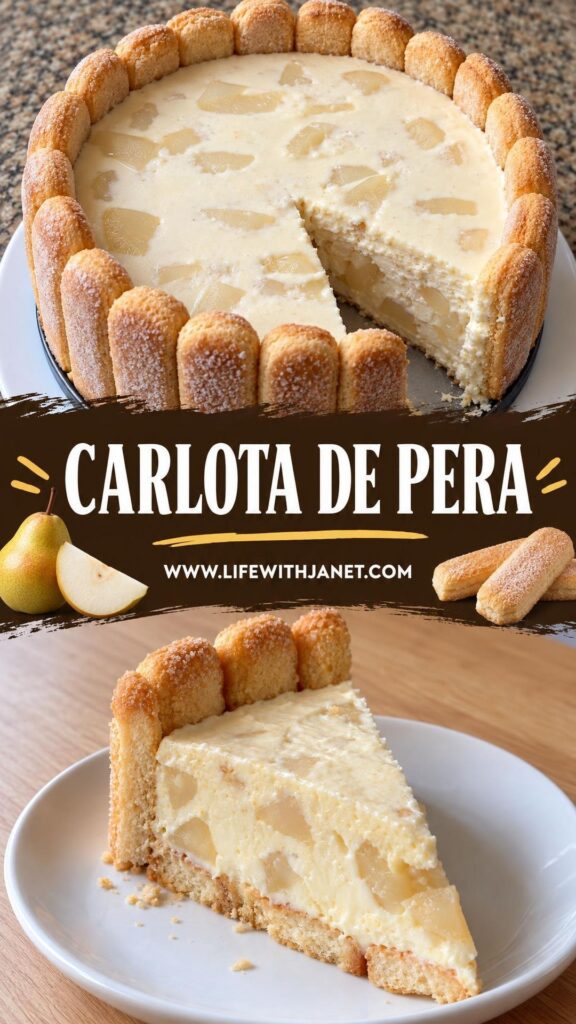
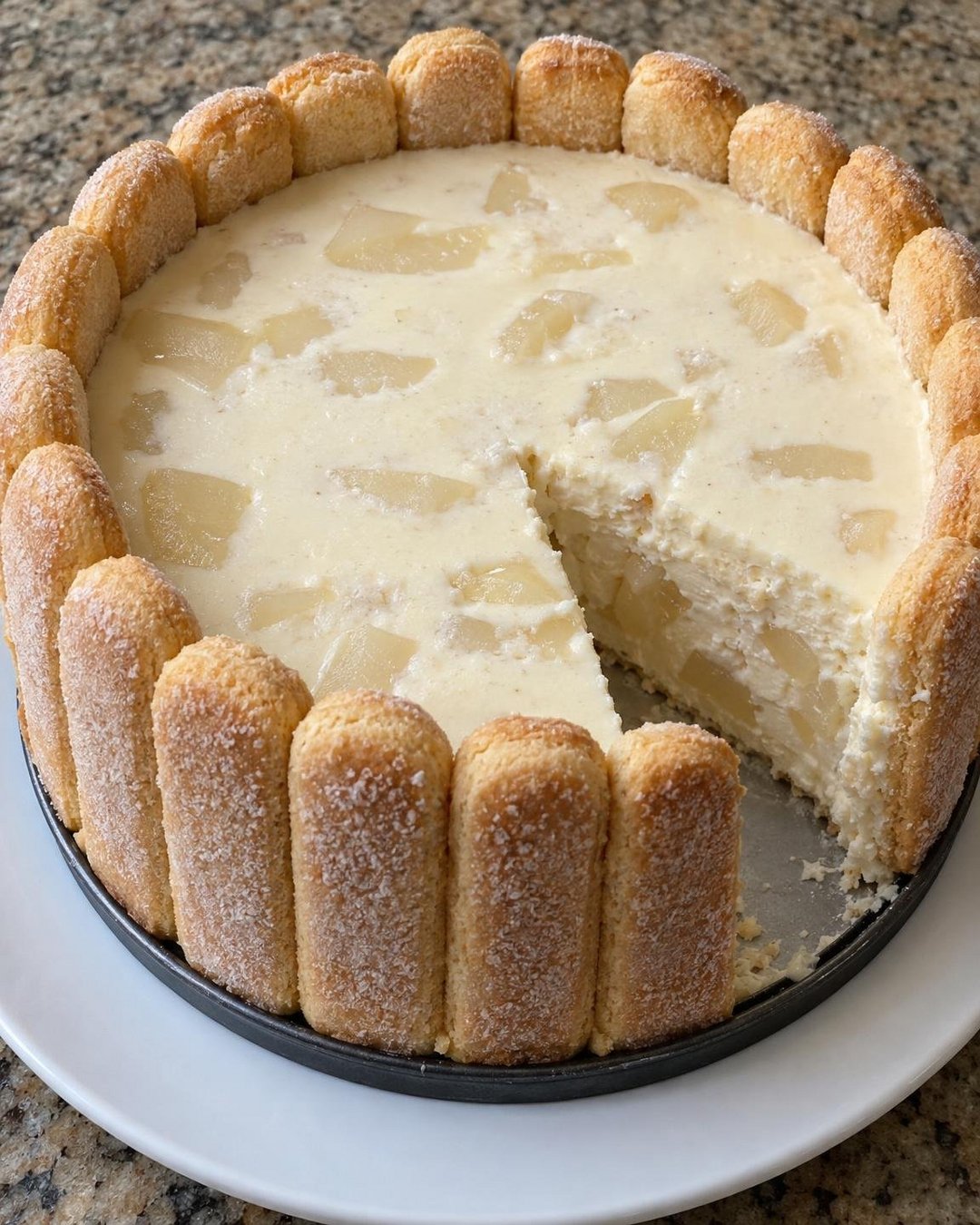
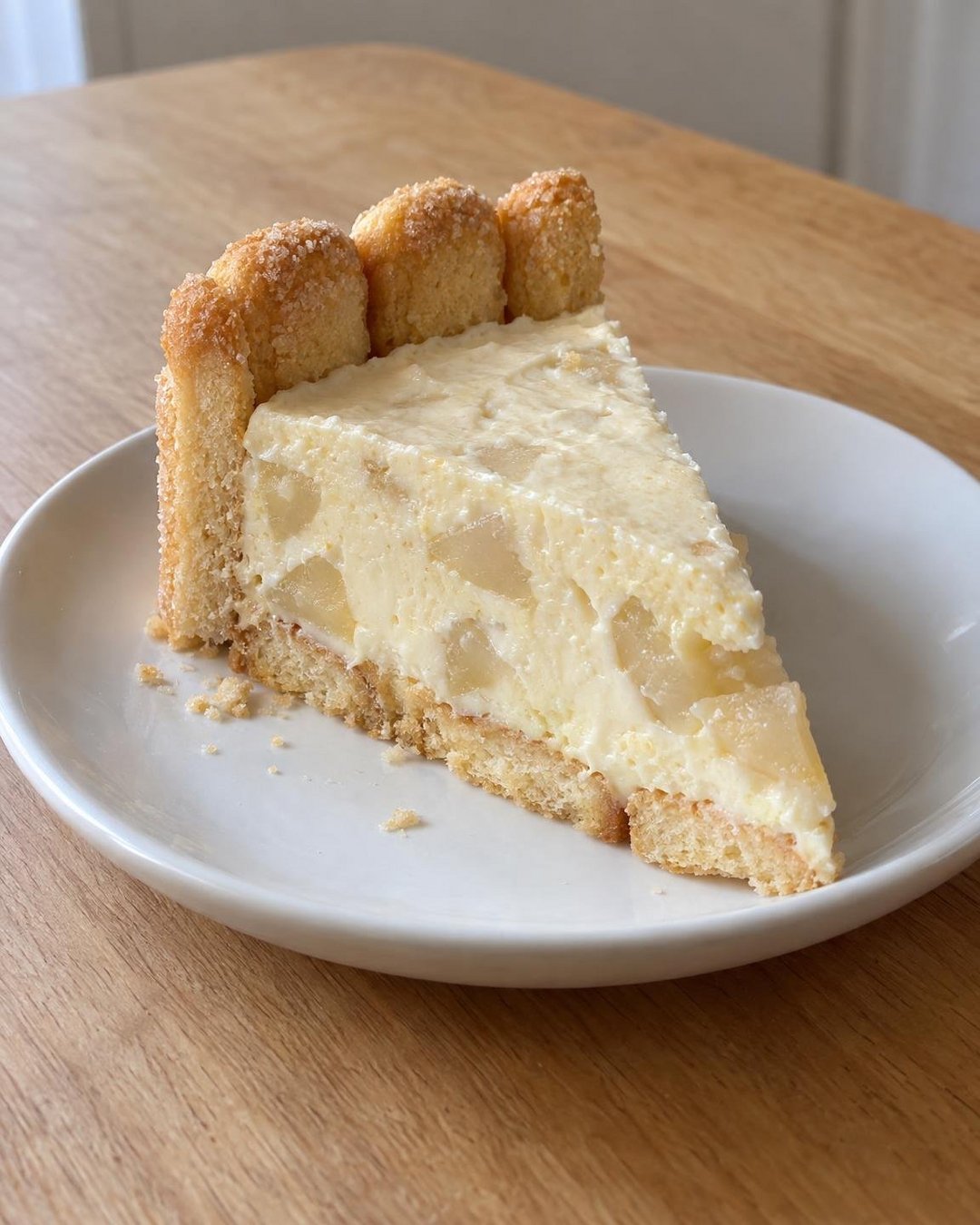
Carlota de Pera is a cool, elegant dessert: a ring of crisp ladyfingers holding a vanilla Bavarian cream studded with soft pear pieces. It sets in the refrigerator, so the oven stays off.
Expect a light, creamy filling, gentle fruit and cookies that soften just enough. The work is spread out, and most of the time is hands-off chilling.
Why You’ll Love This Recipe
- It's made ahead: The charlotte needs at least 6 hours to set, so you can assemble it the day before and simply unmold it before serving.
- Pears in every slice: Small poached pieces are folded right into the cream, so each wedge gets fruit, not just a topping.
- It looks special: The upright ladyfinger wall gives a neat, polished edge with little decorating effort.
Ingredients and Helpful Notes
- pears: Choose ripe but firm Bosc or Anjou so the pieces stay intact after poaching. The weight is measured before peeling and coring.
- granulated sugar: Part sweetens the pears; the rest goes into the custard.
- water: One portion cooks the pears and the other blooms the gelatin. The gelatin portion must be cold.
- lemon juice: Adds brightness to the pears as they cook.
- crisp ladyfinger cookies: Use dry, crisp savoiardi no thicker than 1/2 inch so the shell keeps enough room for the filling.
- unflavored powdered gelatin: Standard retail powder; sheets aren't interchangeable by volume.
- heavy whipping cream: Whip it cold, just to soft peaks.
- whole milk: The base of the custard, heated until steaming.
- large egg yolks: They thicken the custard and are cooked to a safe temperature.
- vanilla extract: Stirred in after cooking so its flavor stays fresh.
How to Make Carlota de Pera
Read through the steps before starting and have the thermometer, ruler and ice bath ready. While the pears cool, line the pan and make the filling.
Equipment: 8-inch springform pan with an interior depth of at least 3 inches; the cookie-lined cavity must hold at least 1.5 liters, approximately 6 1/3 US cups, to the cookie tops; Parchment paper; Medium saucepan with lid; Fine-mesh strainer; Shallow dish; Mixing bowls; Electric mixer or whisk; Flexible spatula; Instant-read thermometer; Pastry brush; Large bowl for an ice-water bath; Ruler.
- Prepare the mold. Line the bottom of the springform pan with parchment paper and place a parchment strip around the inside wall. Check that the pan measures at least 8 inches across inside and 3 inches deep. No oven is needed.
- Cook and cool the pears. Wash 18 ounces pears under running water, then peel, core and cut into 1/2-inch pieces. Put them in a medium saucepan with 3 tablespoons granulated sugar, 3 tablespoons water and 2 1/4 teaspoons lemon juice. Bring to a gentle simmer over medium heat, cover and cook over medium-low heat for 8–12 minutes, stirring occasionally, until a knife enters easily but the pieces still hold their shape. Drain through a strainer, reserving the cooking liquid. Spread the fruit in a shallow dish and refrigerate promptly until cool. Cool the reserved liquid separately.
- Build the ladyfinger shell. Line the pan using 9 ounces crisp ladyfinger cookies. Trim the wall cookies to 3 inches long, giving each a flat end to stand on. Arrange them closely together with their sugared faces against the parchment. Fit a single layer of cookies across the bottom, cutting them as needed and using trimmings to close gaps without stacking. Before proceeding, check that the lined cavity has at least 7 inches of clear diameter and 2 1/2 inches of depth from the cookie base to the cookie tops. These dimensions provide slightly more than the required 1.5 liters of usable lined capacity. Lightly brush the bottom layer with the cooled pear cooking liquid, moistening the surface without soaking it or leaving puddles. Leave the upright cookies dry and discard unused cooking liquid.
- Bloom the gelatin and whip the cream. Pour 3 tablespoons water into a small bowl and sprinkle 2 1/4 teaspoons unflavored powdered gelatin evenly over the surface. Let stand for 5–10 minutes, or according to the package directions, until fully hydrated. In a separate bowl, whip 9 fluid ounces heavy whipping cream to soft peaks: it should hold a gentle mound with a tip that bends over. Refrigerate the whipped cream while making the custard.
- Cook the custard. Wash and dry the saucepan, then heat 9 fluid ounces whole milk over medium-low heat until steaming, without boiling. In a bowl, whisk 3 large egg yolks with 6 tablespoons granulated sugar until evenly combined. Gradually whisk the hot milk into the yolk mixture, then return everything to the saucepan. Cook over low heat, stirring constantly and scraping the bottom and corners, until the custard lightly coats the spatula and reaches 180–182°F on an instant-read thermometer, about 3–6 minutes. Do not let it boil.
- Dissolve the gelatin. Immediately strain the hot custard into a clean bowl. Add the bloomed gelatin and stir until it has completely dissolved, with no visible granules or soft lumps. Stir in 1 1/2 teaspoons vanilla extract.
- Cool the custard without setting it. Set the custard bowl in an ice-water bath, keeping water out of the bowl. Stir frequently for about 10–15 minutes, until the custard is no longer warm but still flows freely. Remove it from the bath before it begins to gel around the edges. If it starts to thicken into lumps, set the bowl briefly over warm water and stir until smooth and fluid again, then let it cool before proceeding.
- Finish the pear filling. Whisk a generous spoonful of the whipped cream into the cooled, fluid custard to lighten it. Gently fold in the rest of the whipped cream with a flexible spatula until no white streaks remain. Drain any liquid that has collected beneath the cooled pears, then fold the fruit into the filling.
- Fill and chill. Immediately spoon all the filling into the ladyfinger-lined pan, distributing the pear pieces evenly. The filling should sit below the cookie tops in the correctly sized shell. Smooth the surface. Cover without touching the filling and refrigerate for at least 6 hours, preferably overnight, until the center is set and moves as a single mass rather than rippling when the pan is gently nudged.
- Unmold and serve cold. Release the springform ring slowly and peel away the parchment collar. For the easiest handling, leave the dessert on the pan base and set it on a serving plate. Cut with a sharp knife, wiping the blade between slices. Return the dessert to the refrigerator promptly after serving.
Tips
- Measure the shell: Check the clear diameter and depth with a ruler before filling. Thick cookies or a doubled base can leave too little room.
- Watch the custard closely: Keep the heat low and stir constantly. If it nears a boil, the yolks can scramble; straining catches small bits.
- Fold while it flows: The custard should feel cool but still pour freely. If it starts to gel in lumps, warm it briefly and stir until smooth, then let it cool again before folding in the cream.
Storage and Reheating
Keep covered and refrigerated at 40°F or below. Use within 3–4 days of cooking the custard; the ladyfingers will soften further during storage.
For make-ahead preparation, assemble the dessert the day before serving and refrigerate overnight.
The cooked pears may be prepared a day ahead. Refrigerate the drained fruit and cooking liquid separately in covered containers, and use the assembled dessert within 3 days.
Serve cold. Reheating is not appropriate for this gelatin-set dessert.
What to Serve With Carlota de Pera
Serve the charlotte in chilled wedges with coffee or unsweetened tea. Unmold it shortly before serving, then return leftovers to the refrigerator promptly.
Frequently Asked Questions
How can you tell it's set?
Nudge the pan gently. The center should move as one mass rather than ripple.
Why are only the bottom cookies brushed?
A light brush flavors the base while the dry upright cookies stay sturdy enough to hold their shape.
Can it be served warm?
No. It's a gelatin-set dessert meant to be served cold, and it shouldn't be reheated.
More Recipes to Try
Carlota de Pera
Ingredients
Method
- Line the bottom of the springform pan with parchment paper and place a parchment strip around the inside wall. Check that the pan measures at least 8 inches across inside and 3 inches deep. No oven is needed.
- Wash 18 ounces pears under running water, then peel, core and cut into 1/2-inch pieces. Put them in a medium saucepan with 3 tablespoons granulated sugar, 3 tablespoons water and 2 1/4 teaspoons lemon juice. Bring to a gentle simmer over medium heat, cover and cook over medium-low heat for 8–12 minutes, stirring occasionally, until a knife enters easily but the pieces still hold their shape. Drain through a strainer, reserving the cooking liquid. Spread the fruit in a shallow dish and refrigerate promptly until cool. Cool the reserved liquid separately.
- Line the pan using 9 ounces crisp ladyfinger cookies. Trim the wall cookies to 3 inches long, giving each a flat end to stand on. Arrange them closely together with their sugared faces against the parchment. Fit a single layer of cookies across the bottom, cutting them as needed and using trimmings to close gaps without stacking. Before proceeding, check that the lined cavity has at least 7 inches of clear diameter and 2 1/2 inches of depth from the cookie base to the cookie tops. These dimensions provide slightly more than the required 1.5 liters of usable lined capacity. Lightly brush the bottom layer with the cooled pear cooking liquid, moistening the surface without soaking it or leaving puddles. Leave the upright cookies dry and discard unused cooking liquid.
- Pour 3 tablespoons water into a small bowl and sprinkle 2 1/4 teaspoons unflavored powdered gelatin evenly over the surface. Let stand for 5–10 minutes, or according to the package directions, until fully hydrated. In a separate bowl, whip 9 fluid ounces heavy whipping cream to soft peaks: it should hold a gentle mound with a tip that bends over. Refrigerate the whipped cream while making the custard.
- Wash and dry the saucepan, then heat 9 fluid ounces whole milk over medium-low heat until steaming, without boiling. In a bowl, whisk 3 large egg yolks with 6 tablespoons granulated sugar until evenly combined. Gradually whisk the hot milk into the yolk mixture, then return everything to the saucepan. Cook over low heat, stirring constantly and scraping the bottom and corners, until the custard lightly coats the spatula and reaches 180–182°F on an instant-read thermometer, about 3–6 minutes. Do not let it boil.
- Immediately strain the hot custard into a clean bowl. Add the bloomed gelatin and stir until it has completely dissolved, with no visible granules or soft lumps. Stir in 1 1/2 teaspoons vanilla extract.
- Set the custard bowl in an ice-water bath, keeping water out of the bowl. Stir frequently for about 10–15 minutes, until the custard is no longer warm but still flows freely. Remove it from the bath before it begins to gel around the edges. If it starts to thicken into lumps, set the bowl briefly over warm water and stir until smooth and fluid again, then let it cool before proceeding.
- Whisk a generous spoonful of the whipped cream into the cooled, fluid custard to lighten it. Gently fold in the rest of the whipped cream with a flexible spatula until no white streaks remain. Drain any liquid that has collected beneath the cooled pears, then fold the fruit into the filling.
- Immediately spoon all the filling into the ladyfinger-lined pan, distributing the pear pieces evenly. The filling should sit below the cookie tops in the correctly sized shell. Smooth the surface. Cover without touching the filling and refrigerate for at least 6 hours, preferably overnight, until the center is set and moves as a single mass rather than rippling when the pan is gently nudged.
- Release the springform ring slowly and peel away the parchment collar. For the easiest handling, leave the dessert on the pan base and set it on a serving plate. Cut with a sharp knife, wiping the blade between slices. Return the dessert to the refrigerator promptly after serving.